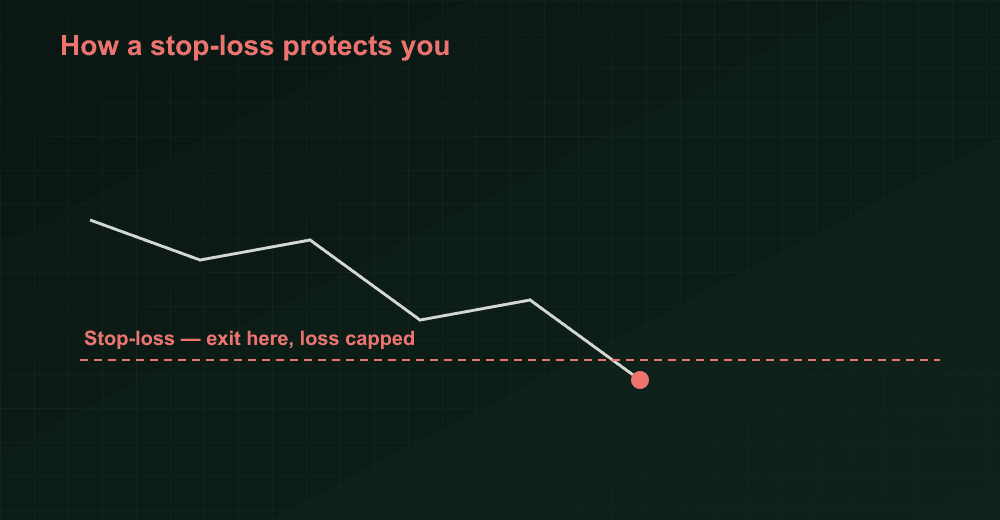
A stop-loss is a pre-set order that exits your trade automatically once price hits a level you choose — capping your loss so no single trade can hurt you badly.
Why every trade needs one
Without a stop, a small loss can snowball while you “hope” it recovers. A stop turns risk into a known, fixed number you decided in advance.
How to place one sensibly
- Put it where your trade idea is proven wrong — e.g., below support.
- Not so tight that normal noise stops you out; not so wide that the loss is huge.
- Size your position from the stop distance.
Key idea: Set your stop before you enter, and never move it further away to avoid taking a loss. That one rule saves accounts.
Trailing stops
As a trade moves your way, a trailing stop follows price to lock in profit while giving the trade room to run.
Key takeaways
- A stop-loss caps your loss automatically.
- Place it where your idea is proven wrong.
- Never widen a stop to avoid a loss.
- Trail your stop to protect profits.
Practise this free on StockYatra
Open a free account, get 10,000 virtual coins and trade live-simulated NEPSE & Indian markets with zero real-money risk.