
There are two main ways to analyse a stock. They answer different questions and work best together.
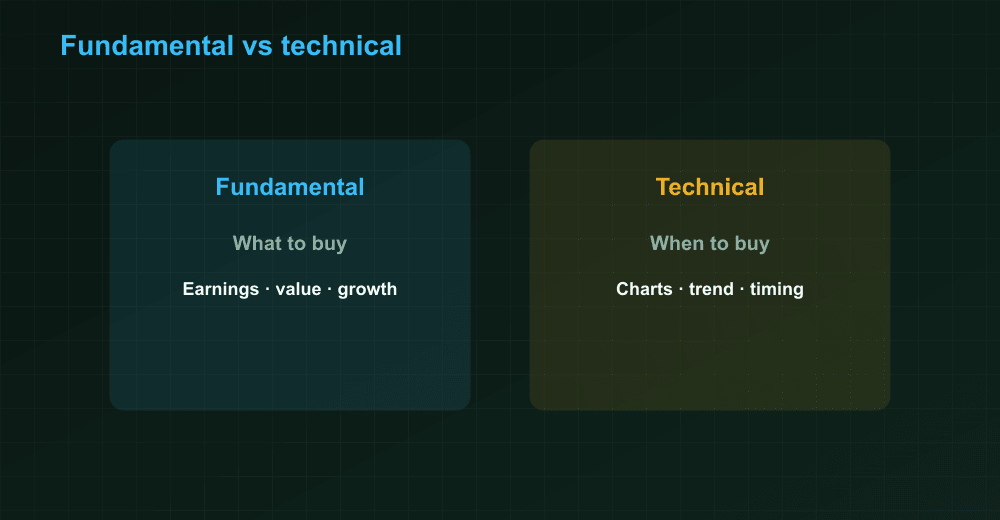
Fundamental analysis
Studies the business: earnings, revenue growth, debt, management and valuation. It answers what is worth owning and at roughly what price.
Technical analysis
Studies the chart: price, trend, volume and patterns. It answers when to enter and exit.
Key idea: Investors lean fundamental; short-term traders lean technical. Many use fundamentals to choose and technicals to time.
Pros and cons
| Fundamental | Technical | |
|---|---|---|
| Best for | Long-term investing | Timing & trading |
| Data | Financial reports | Price & volume |
| Weakness | Slow to signal timing | Ignores value |
Key takeaways
- Fundamental = what to buy; technical = when.
- Investors favour fundamentals; traders favour technicals.
- The two combine well.
- Neither predicts the future — both manage probability.
Practise this free on StockYatra
Open a free account, get 10,000 virtual coins and trade live-simulated NEPSE & Indian markets with zero real-money risk.